
 A Oneindia Venture


 Click it and Unblock the Notifications
Ardi Investment & Trading Company Ltd. కంపెనీ అకౌంటింగ్ విధానాలు
Mar 31, 2025
Corporate Information
Ardi Investment and Trading Co. Ltd (the Company) is a public company domiciled in India and incorporated under the provisions of the Companies Act, 1956. Its shares are listed on one stock exchanges in India (BSE). The Company is principally engaged in business of finance industrial enterprises, and for that purpose to make loans, or advances to, or subscribe to the share capital of private industrial enterprises in India and trading in Agriculture products in India.
Note 1: Material Accounting Policies
i) These financial statements have been prepared in accordance with the Indian Accounting Standards (hereinafter referred to as the âInd AS'') as notified by Ministry of Corporate Affairs pursuant to Section 133 of the Companies Act, 2013 (âAct'') read with of the Companies (Indian Accounting Standards) Rules, 2015 as amended and other relevant provisions of the Act. The accounting policies are applied consistently to all the periods presented in the financial statements.
The financial statements have been prepared under the historical cost convention with the exception of certain financial assets and liabilities which have been measured at fair value, on an accrual basis of accounting.
All the assets and liabilities have been classified as current and non-current as per normal operating cycle of the Company and other criteria set out in as per the guidance set out in Schedule III to the Act. Based on nature of services, the Company ascertained its operating cycle as 12 months for the purpose of current and non-current classification of asset and liabilities.
The Company''s financial statements are reported in Indian Rupees, which is also the Company''s functional currency, and all values are rounded to the nearest lakhs (INR 00,000), except when otherwise indicated.
The preparation of the financial statements, in conformity with the Ind AS, requires the management to make estimates and assumptions that affect the application of accounting policies and the reported amounts of assets and liabilities and disclosure of contingent liabilities as at the date of financial statements and the results of operation during the reported period. Although these estimates are based upon management''s best knowledge of current events and actions, actual results could differ from these estimates which are recognised in the period in which they are determined.
The key assumptions concerning the future and other key sources of estimation uncertainty at the reporting date, that have a material accounting policy of causing a material adjustment
to the carrying amounts of assets and liabilities within the next financial year. The Company based its assumptions and estimates on parameters available when the financial statements were prepared. Existing circumstances and assumptions about future developments, however, may change due to market changes or circumstances arising that are beyond the control of the Company. Such changes are reflected in the financial statements in the period in which changes are made and, if material, their effects are disclosed in the notes to the financial statements.
In assessing the realisability of deferred income tax assets, management considers whether some portion or all of the deferred income tax assets will not be realized. The ultimate realization of deferred income tax assets is dependent upon the generation of future taxable income during the periods in which the temporary differences become deductible. Management considers the scheduled reversals of deferred income tax liabilities, projected future taxable income, and tax planning strategies in making this assessment. Based on the level of historical taxable income and projections for future taxable income over the periods in which the deferred income tax assets are deductible, management believes that the Company will realize the benefits of those deductible differences. The amount of the deferred income tax assets considered realizable, however, could be reduced in the near term if estimates of future taxable income during the carry forward period are reduced.
A financial instrument is any contract that gives rise to a financial asset of one entity and a financial liability or equity instrument of another entity.
a) Financial AssetsInitial Recognition
In the case of financial assets, not recorded at fair value through profit or loss (FVPL), financial assets are recognised initially at fair value plus transaction costs that are directly attributable to the acquisition of the financial asset. Purchases or sales of financial assets that require delivery of assets within a time frame established by regulation or convention in the market place (regular way trades) are recognised on the trade date, i.e., the date that the Company commits to purchase or sell the asset.
For purposes of subsequent measurement, financial assets are classified in following categories:
Financial Assets at Amortised Cost
Financial assets are subsequently measured at amortised cost if these financial assets are held within a business model with an objective to hold these assets in order to collect contractual cash flows and the contractual terms of the financial asset give rise on specified
dates to cash flows that are solely payments of principal and interest on the principal amount outstanding. Interest income from these financial assets is included in finance income using the effective interest rate (âEIRâ) method. Impairment gains or losses arising on these assets are recognised in the Statement of Profit and Loss.
Financial Assets Measured at Fair Value
Financial assets are measured at fair value through Other comprehensive income( âOCI'' )if these financial assets are held within a business model with an objective to hold these assets in order to collect contractual cash flows or to sell these financial assets and the contractual terms of the financial asset give rise on specified dates to cash flows that are solely payments of principal and interest on the principal amount outstanding. Movements in the carrying amount are taken through OCI, except for the recognition of impairment gains or losses, interest revenue and foreign exchange gains and losses which are recognised in the Statement of Profit and Loss. Financial asset not measured at amortised cost or at fair value through OCI is carried at FVPL.â
Impairment of Financial Assets
In accordance with Ind AS 109, the Company applies the expected credit loss (ââECLââ) model for measurement and recognition of impairment loss on financial assets and credit risk exposures.
The Company follows âsimplified approach'' for recognition of impairment loss allowance on trade receivables. Simplified approach does not require the Company to track changes in credit risk. Rather, it recognises impairment loss allowance based on lifetime ECL at each reporting date, right from its initial recognition.
For recognition of impairment loss on other financial assets and risk exposure, the Company determines that whether there has been a significant increase in the credit risk since initial recognition. If credit risk has not increased significantly, 12-month ECL is used to provide for impairment loss. However, if credit risk has increased significantly, lifetime ECL is used. If, in a subsequent period, credit quality of the instrument improves such that there is no longer a significant increase in credit risk since initial recognition, then the entity reverts to recognising impairment loss allowance based on 12-month ECL.
ECL is the difference between all contractual cash flows that are due to the group in accordance with the contract and all the cash flows that the entity expects to receive (i.e., all cash shortfalls), discounted at the original EIR. Lifetime ECL are the expected credit losses resulting from all possible default events over the expected life of a financial instrument. The 12-month ECL is a portion of the lifetime ECL which results from default events that are possible within 12 months after the reporting date.
ECL impairment loss allowance (or reversal) recognised during the period is recognised as income/ expense in the Statement of Profit and Loss.â
De-recognition of Financial Assets
The Company de-recognises a financial asset only when the contractual rights to the cash flows from the asset expire, or it transfers the financial asset and substantially all risks and rewards of ownership of the asset to another entity.
If the Company neither transfers nor retains substantially all the risks and rewards of ownership and continues to control the transferred asset, the Company recognizes its retained interest in the assets and an associated liability for amounts it may have to pay.
If the Company retains substantially all the risks and rewards of ownership of a transferred financial asset, the Company continues to recognise the financial asset and also recognises a collateralised borrowing for the proceeds received.
b) Equity Instruments and Financial Liabilities
Financial liabilities and equity instruments issued by the Company are classified according to the substance of the contractual arrangements entered into and the definitions of a financial liability and an equity instrument.
An equity instrument is any contract that evidences a residual interest in the assets of the Company after deducting all of its liabilities. Equity instruments which are issued for cash are recorded at the proceeds received. Equity instruments which are issued for consideration other than cash are recorded at fair value of the equity instrument.
Financial Liabilities1) Initial Recognition
Financial liabilities are classified, at initial recognition, as financial liabilities at FVPL, loans and borrowings and payables as appropriate. All financial liabilities are recognised initially at fair value and, in the case of loans and borrowings and payables.
The measurement of financial liabilities depends on their classification, as described below Financial liabilities at FVPL
Financial liabilities at FVPL include financial liabilities held for trading and financial liabilities designated upon initial recognition as at FVPL. Financial liabilities are classified as held for trading if they are incurred for the purpose of repurchasing in the near term. Gains or losses on liabilities held for trading are recognised in the Statement of Profit and Loss.
Financial liabilities at amortised cost
After initial recognition, interest-bearing loans and borrowings are subsequently measured at amortised cost using the EIR method. Any difference between the proceeds (net of transaction costs) and the settlement or redemption of borrowings is recognised over the term of the borrowings in the Statement of Profit and Loss.
Amortised cost is calculated by taking into account any discount or premium on acquisition and fees or costs that are an integral part of the EIR. The EIR amortisation is included as finance costs in the Statement of Profit and Loss.â
3) De-recognition of Financial Liabilities
Financial liabilities are de-recognised when the obligation specified in the contract is discharged, cancelled or expired. When an existing financial liability is replaced by another from the same lender on substantially different terms, or the terms of an existing liability are substantially modified, such an exchange or modification is treated as de-recognition of the original liability and recognition of a new liability. The difference in the respective carrying amounts is recognised in the Statement of Profit and Loss.
c) Offsetting Financial Instruments
Financial assets and financial liabilities are offset and the net amount is reported in the Balance Sheet if there is a currently enforceable legal right to offset the recognised amounts and there is an intention to settle on a net basis to realise the assets and settle the liabilities simultaneously.
Cash and cash equivalents in the Balance Sheet comprises of cash at banks and on hand , which are subject to an insignificant risk of changes in value.
a) Revenue is recognized to the extent that it is probable that the economic benefits will flow to the Company and the revenue can be reliably measured.
b) Sales are excluding GST and are stated net of discounts, returns and rebates.
Income tax comprises of current and deferred income tax. Income tax is recognised as an expense or income in the Statement of Profit and Loss, except to the extent it relates to items directly recognised in equity or in OCI.
Current income tax is recognised based on the estimated tax liability computed after taking credit for allowances and exemptions in accordance with the Income Tax Act, 1961. Current income tax assets and liabilities are measured at the amount expected to be recovered from or paid to the taxation authorities. The tax rates and tax laws used to compute the amount are those that are enacted or substantively enacted, at the reporting date.
Deferred tax is determined by applying the Balance Sheet approach. Deferred tax assets and liabilities are recognised for all deductible temporary differences between the financial
statements'' carrying amount of existing assets and liabilities and their respective tax base. Deferred tax assets and liabilities are measured using the enacted tax rates or tax rates that are substantively enacted at the Balance Sheet date. The effect on deferred tax assets and liabilities of a change in tax rates is recognised in the period that includes the enactment date. Deferred tax assets are only recognised to the extent that it is probable that future taxable profits will be available against which the temporary differences can be utilised. Such assets are reviewed at each Balance Sheet date to reassess realisation.
Deferred tax assets and liabilities are offset when there is a legally enforceable right to offset. Current tax assets and tax liabilities are offset where the entity has a legally enforceable right to offset and intends either to settle on a net basis, or to realise the asset and settle the liability simultaneously.
Minimum Alternative Tax (âMATâ) credit is recognised as an asset only when and to the extent it is probable that the Company will pay normal income tax during the specified period.
A receivable is classified as a âtrade receivable'' if it is in respect of the amount due on account of goods sold or services rendered in the normal course of business. Trade receivables are recognised initially at fair value and subsequently measured at amortised cost using the EIR method, less provision for impairment.
A payable is classified as a âtrade payable'' if it is in respect of the amount due on account of goods purchased or services received in the normal course of business. These amounts represent liabilities for goods and services provided to the Company prior to the end of the financial year which are unpaid. These amounts are unsecured and are usually settled as per the payment terms stated in the contract. Trade and other payables are presented as current liabilities unless payment is not due within 12 months after the reporting period. They are recognised initially at their fair value and subsequently measured at amortised cost using the EIR method.
Basic earnings per share is computed by dividing the net profit or loss for the period attributable to the equity shareholders of the Company by the weighted average number of equity shares outstanding during the period. The weighted average number of equity shares outstanding during the period and for all periods presented is adjusted for events, such as bonus shares, other than the conversion of potential equity shares, that have changed the number of equity shares outstanding, without a corresponding change in resources.
Diluted earnings per share is computed by dividing the net profit or loss for the period attributable to the equity shareholders of the Company and weighted average number of equity shares considered for deriving basic earnings per equity share and also the weighted
average number of equity shares that could have been issued upon conversion of all dilutive potential equity shares. The dilutive potential equity shares are adjusted for the proceeds receivable had the equity shares been actually issued at fair value (i.e. the average market value of the outstanding equity shares).
x) Provisions, Contingent Liabilities and Contingent Assets
A provision is recognised when the Company has a present obligation (legal or constructive) as a result of past events and it is probable that an outflow of resources embodying economic benefits will be required to settle the obligation, in respect of which a reliable estimate can be made of the amount of obligation. Provisions (excluding gratuity and compensated absences) are determined based on management''s estimate required to settle the obligation at the Balance Sheet date. In case the time value of money is material, provisions are discounted using a current pre-tax rate that reflects the risks specific to the liability. When discounting is used, the increase in the provision due to the passage of time is recognised as a finance cost. These are reviewed at each Balance Sheet date and adjusted to reflect the current management estimates.
Contingent liabilities are disclosed in respect of possible obligations that arise from past events, whose existence would be confirmed by the occurrence or non-occurrence of one or more uncertain future events not wholly within the control of the Company. A contingent liability also arises, in rare cases, where a liability cannot be recognised because it cannot be measured reliably.
Cash flows are reported using the indirect method, where by net profit before tax is adjusted for the effects of transactions of a non-cash nature, any deferrals or accruals of past or future operating cash receipts or payments and item of income or expenses associated with investing or financing cash flows. The cash flows from operating, investing and financing activities are segregated.
Note 14: Property, Plant and Equipment
The Company has Asset in form of Intangible name called Legality at the end of the year.
Mar 31, 2024
Note 1: Material Accounting Policies
i) These financial statements have been prepared in accordance with the Indian Accounting
Standards (hereinafter referred to as the âInd AS'') as notified by Ministry of Corporate Affairs
pursuant to Section 133 of the Companies Act, 2013 (âAct'') read with of the Companies (Indian
Accounting Standards) Rules, 2015 as amended and other relevant provisions of the Act. The
accounting policies are applied consistently to all the periods presented in the financial
statements.
The financial statements have been prepared under the historical cost convention with the
exception of certain financial assets and liabilities which have been measured at fair value, on an
accrual basis of accounting.
All the assets and liabilities have been classified as current and non-current as per normal
operating cycle of the Company and other criteria set out in as per the guidance set out in
Schedule III to the Act. Based on nature of services, the Company ascertained its operating cycle
as 12 months for the purpose of current and non-current classification of asset and liabilities.
The Company''s financial statements are reported in Indian Rupees, which is also the Company''s
functional currency, and all values are rounded to the nearest lakhs (INR 00,000), except when
otherwise indicated.
ii) Accounting Estimates
The preparation of the financial statements, in conformity with the Ind AS, requires the
management to make estimates and assumptions that affect the application of accounting
policies and the reported amounts of assets and liabilities and disclosure of contingent liabilities
as at the date of financial statements and the results of operation during the reported period.
Although these estimates are based upon management''s best knowledge of current events and
actions, actual results could differ from these estimates which are recognised in the period in
which they are determined.
Estimates and assumptions
The key assumptions concerning the future and other key sources of estimation uncertainty at
the reporting date, that have a material accounting policy of causing a material adjustment to the
carrying amounts of assets and liabilities within the next financial year. The Company based its
assumptions and estimates on parameters available when the financial statements were
prepared. Existing circumstances and assumptions about future developments, however, may
change due to market changes or circumstances arising that are beyond the control of the
Company. Such changes are reflected in the financial statements in the period in which changes
are made and, if material, their effects are disclosed in the notes to the financial statements.
Deferred tax assets
In assessing the realisability of deferred income tax assets, management considers whether
some portion or all of the deferred income tax assets will not be realized. The ultimate
realization of deferred income tax assets is dependent upon the generation of future taxable
income during the periods in which the temporary differences become deductible. Management
considers the scheduled reversals of deferred income tax liabilities, projected future taxable
income, and tax planning strategies in making this assessment. Based on the level of historical
taxable income and projections for future taxable income over the periods in which the deferred
income tax assets are deductible, management believes that the Company will realize the
benefits of those deductible differences. The amount of the deferred income tax assets
considered realizable, however, could be reduced in the near term if estimates of future taxable
income during the carry forward period are reduced.
iii) Financial Instruments
A financial instrument is any contract that gives rise to a financial asset of one entity and a
financial liability or equity instrument of another entity.
a) Financial Assets
Initial Recognition
In the case of financial assets, not recorded at fair value through profit or loss (FVPL), financial
assets are recognised initially at fair value plus transaction costs that are directly attributable to
the acquisition of the financial asset. Purchases or sales of financial assets that require delivery
of assets within a time frame established by regulation or convention in the market place
(regular way trades) are recognised on the trade date, i.e., the date that the Company commits to
purchase or sell the asset.
Subsequent Measurement
For purposes of subsequent measurement, financial assets are classified in following categories:
Financial Assets at Amortised Cost
Financial assets are subsequently measured at amortised cost if these financial assets are held
within a business model with an objective to hold these assets in order to collect contractual
cash flows and the contractual terms of the financial asset give rise on specified dates to cash
flows that are solely payments of principal and interest on the principal amount outstanding.
Interest income from these financial assets is included in finance income using the effective
interest rate (âEIRâ) method. Impairment gains or losses arising on these assets are recognised
in the Statement of Profit and Loss.
Financial Assets Measured at Fair Value
Financial assets are measured at fair value through Other comprehensive income( âOCI'' )if these
financial assets are held within a business model with an objective to hold these assets in order
to collect contractual cash flows or to sell these financial assets and the contractual terms of the
financial asset give rise on specified dates to cash flows that are solely payments of principal and
interest on the principal amount outstanding. Movements in the carrying amount are taken
through OCI, except for the recognition of impairment gains or losses, interest revenue and
foreign exchange gains and losses which are recognised in the Statement of Profit and Loss.
Financial asset not measured at amortised cost or at fair value through OCI is carried at FVPL.â
Impairment of Financial Assets
In accordance with Ind AS 109, the Company applies the expected credit loss (ââECLââ) model for
measurement and recognition of impairment loss on financial assets and credit risk exposures.
The Company follows âsimplified approach'' for recognition of impairment loss allowance on
trade receivables. Simplified approach does not require the Company to track changes in credit
risk. Rather, it recognises impairment loss allowance based on lifetime ECL at each reporting
date, right from its initial recognition.
For recognition of impairment loss on other financial assets and risk exposure, the Company
determines that whether there has been a significant increase in the credit risk since initial
recognition. If credit risk has not increased significantly, 12-month ECL is used to provide for
impairment loss. However, if credit risk has increased significantly, lifetime ECL is used. If, in a
subsequent period, credit quality of the instrument improves such that there is no longer a
significant increase in credit risk since initial recognition, then the entity reverts to recognising
impairment loss allowance based on 12-month ECL.
ECL is the difference between all contractual cash flows that are due to the group in accordance
with the contract and all the cash flows that the entity expects to receive (i.e., all cash shortfalls),
discounted at the original EIR. Lifetime ECL are the expected credit losses resulting from all
possible default events over the expected life of a financial instrument. The 12-month ECL is a
portion of the lifetime ECL which results from default events that are possible within 12 months
after the reporting date.
ECL impairment loss allowance (or reversal) recognised during the period is recognised as
income/ expense in the Statement of Profit and Loss.â
De-recognition of Financial Assets
The Company de-recognises a financial asset only when the contractual rights to the cash flows
from the asset expire, or it transfers the financial asset and substantially all risks and rewards of
ownership of the asset to another entity.
If the Company neither transfers nor retains substantially all the risks and rewards of ownership
and continues to control the transferred asset, the Company recognizes its retained interest in
the assets and an associated liability for amounts it may have to pay.
If the Company retains substantially all the risks and rewards of ownership of a transferred
financial asset, the Company continues to recognise the financial asset and also recognises a
collateralised borrowing for the proceeds received.
b) Equity Instruments and Financial Liabilities
Financial liabilities and equity instruments issued by the Company are classified according to the
substance of the contractual arrangements entered into and the definitions of a financial liability
and an equity instrument.
Equity Instruments
An equity instrument is any contract that evidences a residual interest in the assets of the
Company after deducting all of its liabilities. Equity instruments which are issued for cash are
recorded at the proceeds received. Equity instruments which are issued for consideration other
than cash are recorded at fair value of the equity instrument.
Financial Liabilities
1) Initial Recognition
Financial liabilities are classified, at initial recognition, as financial liabilities at FVPL, loans and
borrowings and payables as appropriate. All financial liabilities are recognised initially at fair
value and, in the case of loans and borrowings and payables.
2) Subsequent Measurement
The measurement of financial liabilities depends on their classification, as described below
Financial liabilities at FVPL
Financial liabilities at FVPL include financial liabilities held for trading and financial liabilities
designated upon initial recognition as at FVPL. Financial liabilities are classified as held for
trading if they are incurred for the purpose of repurchasing in the near term. Gains or losses on
liabilities held for trading are recognised in the Statement of Profit and Loss.
Financial liabilities at amortised cost
After initial recognition, interest-bearing loans and borrowings are subsequently measured at
amortised cost using the EIR method. Any difference between the proceeds (net of transaction
costs) and the settlement or redemption of borrowings is recognised over the term of the
borrowings in the Statement of Profit and Loss.
Amortised cost is calculated by taking into account any discount or premium on acquisition and
fees or costs that are an integral part of the EIR. The EIR amortisation is included as finance costs
in the Statement of Profit and Loss.â
3) De-recognition of Financial Liabilities
Financial liabilities are de-recognised when the obligation specified in the contract is discharged,
cancelled or expired. When an existing financial liability is replaced by another from the same
lender on substantially different terms, or the terms of an existing liability are substantially
modified, such an exchange or modification is treated as de-recognition of the original liability
and recognition of a new liability. The difference in the respective carrying amounts is
recognised in the Statement of Profit and Loss.
c) Offsetting Financial Instruments
Financial assets and financial liabilities are offset and the net amount is reported in the Balance
Sheet if there is a currently enforceable legal right to offset the recognised amounts and there is
an intention to settle on a net basis to realise the assets and settle the liabilities simultaneously.
iv) Cash and Cash Equivalents
Cash and cash equivalents in the Balance Sheet comprises of cash at banks and on hand , which
are subject to an insignificant risk of changes in value.
v) Revenue Recognition
a) Revenue is recognized to the extent that it is probable that the economic benefits will flow to
the Company and the revenue can be reliably measured.
b) Sales are excluding GST and are stated net of discounts, returns and rebates.
vi) Income Tax
Income tax comprises of current and deferred income tax. Income tax is recognised as an
expense or income in the Statement of Profit and Loss, except to the extent it relates to items
directly recognised in equity or in OCI.
a. Current Income Tax
Current income tax is recognised based on the estimated tax liability computed after taking
credit for allowances and exemptions in accordance with the Income Tax Act, 1961. Current
income tax assets and liabilities are measured at the amount expected to be recovered from or
paid to the taxation authorities. The tax rates and tax laws used to compute the amount are those
that are enacted or substantively enacted, at the reporting date.
b. Deferred Income Tax
Deferred tax is determined by applying the Balance Sheet approach. Deferred tax assets and
liabilities are recognised for all deductible temporary differences between the financial
statements'' carrying amount of existing assets and liabilities and their respective tax base.
Deferred tax assets and liabilities are measured using the enacted tax rates or tax rates that are
substantively enacted at the Balance Sheet date. The effect on deferred tax assets and liabilities
of a change in tax rates is recognised in the period that includes the enactment date. Deferred tax
assets are only recognised to the extent that it is probable that future taxable profits will be
available against which the temporary differences can be utilised. Such assets are reviewed at
each Balance Sheet date to reassess realisation.
Deferred tax assets and liabilities are offset when there is a legally enforceable right to offset.
Current tax assets and tax liabilities are offset where the entity has a legally enforceable right to
offset and intends either to settle on a net basis, or to realise the asset and settle the liability
simultaneously.
Minimum Alternative Tax (âMATâ) credit is recognised as an asset only when and to the extent it
is probable that the Company will pay normal income tax during the specified period.
vii) Trade Receivables
A receivable is classified as a âtrade receivable'' if it is in respect of the amount due on account of
goods sold or services rendered in the normal course of business. Trade receivables are
recognised initially at fair value and subsequently measured at amortised cost using the EIR
method, less provision for impairment.
viii) Trade Payables
A payable is classified as a âtrade payable'' if it is in respect of the amount due on account of goods
purchased or services received in the normal course of business. These amounts represent
liabilities for goods and services provided to the Company prior to the end of the financial year
which are unpaid. These amounts are unsecured and are usually settled as per the payment
terms stated in the contract. Trade and other payables are presented as current liabilities unless
payment is not due within 12 months after the reporting period. They are recognised initially at
their fair value and subsequently measured at amortised cost using the EIR method.
ix) Earnings Per Share
Basic earnings per share is computed by dividing the net profit or loss for the period attributable
to the equity shareholders of the Company by the weighted average number of equity shares
outstanding during the period. The weighted average number of equity shares outstanding
during the period and for all periods presented is adjusted for events, such as bonus shares,
other than the conversion of potential equity shares, that have changed the number of equity
shares outstanding, without a corresponding change in resources.
Diluted earnings per share is computed by dividing the net profit or loss for the period
attributable to the equity shareholders of the Company and weighted average number of equity
shares considered for deriving basic earnings per equity share and also the weighted average
number of equity shares that could have been issued upon conversion of all dilutive potential
equity shares. The dilutive potential equity shares are adjusted for the proceeds receivable had
the equity shares been actually issued at fair value (i.e. the average market value of the
outstanding equity shares).
Mar 31, 2012
1. General Information
Ardi Investment And Trading Co. Ltd , incorporated on 01st August 1981,
with the Registrar of Companies, Maharashtra.
2. Summary Of Significant Accounting Policies
2.1 Basis Of Preparation Of Financial Statements (AS-1)
The Financial statements have been prepared under the historical cost
convention on the accrual basis in accordance with Generally Accepted
Accounting Principles in India, and materially comply with the
mandatory accounting standards issued by the Institute of Chartered
Accountants of India (ICAI) and the provisions of .the Companies Act,
1956. Accounting standards have been consistently applied except where
a newly issued accounting standard is initially adopted or a revision
to an existing accounting standard requires a change in the accounting
policy hitherto in use. Management evaluates all recently issued or
revised accounting standards on an ongoing basis. The fundamental
assumptions i.e Going concern, Consistency and accrual has been
followed.
2.2 Use Of Estimates
The preparation of financial statements requires estimates and
assumptions to be made that affect the reported amount of assets and
liabilities on the date of the financial statements and the reported
amount of revenues and expenses during the reporting period. Difference
between the actual results and estimates are recognised in the period
in which the results are known/ materialized.
2.3 Revenue Recognition (AS-9)
2.3.1 Revenue is recognized only when it can be reliably measured and
it is reasonable to expect ultimate collection.
23.2 Direct fiscal duties and taxes are charged out as an expense in
the year in which they are paid or provided.
2.4 Retirement & Other Employee Benefits (AS-15)
2.4.1 Provident Fund
Employees receive benefits from a provident fund, which is a defined
contribution plan. Both the employee and the company make monthly
contributions to the Employee''s Provident Fund equal to the specified
percentage of the covered employee''s salary. The company has no further
obligation beyond its monthly contributions.
2.4.2 Gratuity The company has not made and provision for gratuity
liability but the provision will be made as and when it will be
recognized.
2. 4 .3 Leave Encashment As per the employment policy of the company,
employees are required to avail their annual leave by the year end of
the respective financial year and a provision have been made for leave
balance as at the year end.
2. 5 Taxes On Income (AS-22)
2.5.1 Currents tax is determined, under the at payable method based on
the liability as computed after taking credit for allowances and
exemptions. Adjustments in books are made only after the completion of
the assessment
2.5.2 Deferred tax is recognised, subject to the consideration of
Prudence, on timing differences, being the difference between taxable
incomes and accounting income, that originate in one period and reverse
in one or more subsequent periods.
2.6 Provisions
Provisions are recognized when the company has present legal or
constructive obligation, as a result of past events, for which it is
probable that an outflow of economic benefits will be required to
settle the obligation and a reliable estimate can be made for the
amount of the obligation.
Mar 31, 2011
1. BASIS OF PREPARATION OF FINANCIAL STATEMENTS AS-1)
The Financial statements have been prepared under the historical cost
convention on the accrual basis in accordance with Generally Accepted
Accounting Principles in India, and materially comply with the
mandatory accounting standards issued by the Institute of Chartered
Accountants of India (ICAIJ and the provisions of the Companies Act,
1956. Accounting standards have been consistently applied except where
a newly issued accounting standard is initially adopted or a revision
to an existing accounting standard requires a change in the accounting
policy hitherto in use. Management evaluates all recently issued or
revised accounting standards on an ongoing basis.
2. TAXES ON INCOME AS-22)
i) Current tax is determined, under the tax payable method based on the
liability as computed after taking credit for allowances and
exemptions. Adjustments in books are made only after the completion of
the assessment
ii) Deferred tax is recognized, subject to the consideration of
prudence, on timing differences, being the difference between taxable
incomes and accounting income, that originate in one period and reverse
in one or more subsequent periods.
3. RELATED PARTY
Related party disclosure under accounting standard-18 issued by 1CAI is
not applicable Th ere is no related part transaction.
Disclaimer: This is 3rd Party content/feed, viewers are requested to use their discretion and conduct proper diligence before investing, GoodReturns does not take any liability on the genuineness and correctness of the information in this article
మరింత సమాచారం Ardi Investment & Trading Company Ltd.
-
Ardi Investment & Trading Company Ltd. కంపెనీ వివరాలు
- కంపెనీ ప్రొఫైల్
- కంపెనీ చరిత్ర
- నిర్వహణ బృందం
- క్యాపిటల్ స్ట్రక్చర్
- ప్రొడక్ట్ మిక్స్
- బ్యాంకర్/ఆడిటర్/రిజిస్ట్రార్
-
Ardi Investment & Trading Company Ltd. ముఖ్య ఆర్థిక నిష్పత్తులు
- నిష్పత్తులు
-
Ardi Investment & Trading Company Ltd. ఫలితాలు
- క్వార్టర్లీ ఫలితాలు
- హాఫ్ ఇయర్లీ ఫలితాలు
- 9నెలల ఫలితాలు
- వార్షిక ఫలితాలు
-
Ardi Investment & Trading Company Ltd. ఆర్థిక డేటా
- ఆడిట్ ఫలితాలు
- క్యాష్ ఫ్లో
- బ్యాలెన్స్ షీట్
-
Ardi Investment & Trading Company Ltd. నివేదికలు
- అకౌంటింగ్ విధానాలు
- ఆడిటర్స్ నివేదిక
- డైరక్టర్స్ నివేదిక
- ఖాతాకు గమనికలు
-
Ardi Investment & Trading Company Ltd. కార్పొరేట్ ప్రకటనలు
- బుక్ క్లోజర్
- బోర్డు సమావేశాలు
-
 బ్లూ-చిప్ స్టాక్లలో కొనుగోళ్ల జోరు.. 609 పాయింట్లు ఎగబాకిన సెన్సెక్స్.. 24177 పాయింట్ల వద్ద ముగిసిన నిఫ్టీ..
 -
 నష్టాల్లో ముగిసిన సూచీలు.. 24 వేల మార్క్ దిగువకు నిఫ్టీ.. 417 పాయింట్లు కోల్పోయిన సెన్సెక్స్..
 -
 HCL share: స్టాక్ పడిపోతుంటే ఇన్వెస్టర్లు ఎందుకు కొంటున్నారు? HCL టెక్ వెనుక ఉన్న అసలు సీక్రెట్ ఇదే!
 -
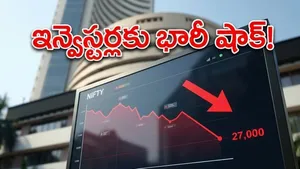 నిఫ్టీ టార్గెట్ తగ్గింపు.. భారత మార్కెట్కు జేపీ మోర్గాన్ షాక్!
 -
 స్టాక్ మార్కెట్ భారీ క్రాష్.. రూ. 6 లక్షల కోట్లు ఆవిరి.. మూడు రోజుల్లో సెన్సెక్స్ 2,600 పాయింట్లు ఢమాల్..
 -
 మూడో రోజు కూడా కుప్పకూలిన స్టాక్ మార్కెట్.. భారీ నష్టాలతో ఇన్వెస్టర్లు విలవిల
 -
 కుప్పకూలిన స్టాక్ మార్కెట్.. భారీ నష్టాల్లో ఐటీ రంగం షేర్లు.. ఇన్వెస్టర్లు లబోదిబో..
 -
 Stock market: పెరుగుతున్న స్టాక్ మార్కెట్! చమురు ధరలు తగ్గడమే కారణమా? ఇన్వెస్టర్లు ఇప్పుడేం చేయాలంటే..
 -
 ఇన్వెస్టర్లు డబ్బుతో రెడీగా ఉండండి.. రేపు బలంగా ర్యాలీ చేయనున్న నిఫ్టీ.. కారణాలు ఇవే..
 -
 IPO: స్టాక్ మార్కెట్ చరిత్రలోనే కీలక అడుగు.. ఏప్రిల్ 20న ఏం జరగబోతోంది?
 -
 బలంగా ప్రారంభమై యూ-టర్న్ తీసుకున్న మార్కెట్..సెన్సెక్స్ 300 పాయింట్లు ఢమాల్.. కారణం ఏంటంటే..
 -
 Stock market: వర్షం పడితేనే స్టాక్ మార్కెట్లో లాభాల పంట! మాన్సూన్ ఎఫెక్ట్ వెనుక ఉన్న అసలు రహస్యం ఇదే!
 -
 Stock Market: సెన్సెక్స్ టాప్ లూజర్స్ ఇవే.. ఇన్వెస్టర్లు అప్రమత్తంగా ఉండాలా, లేక ఇన్వెస్ట్ చేయాలా?
 -
 Stock market: ఐటీ స్టాక్స్ క్రాష్! నిఫ్టీ ఐటీ ఇండెక్స్ డౌన్.. భారీ నష్టాల్లో టాప్ కంపెనీలు!
 -
 Stock market: సెన్సెక్స్ పతనం.. కానీ రికవరీ మొదలైందా? నేటి మార్కెట్ టాప్ విన్నర్స్ వీరే!
-
Block for 8 hours
-
Block for 12 hours
-
Block for 24 hours
-
Don't block

 Sign in with Google
- Male
- Female
- Others
- Under 18
- 18 to 25
- 26 to 35
- 36 to 45
- 45 to 55
- 55+